

Crossdressing for Beginners: A Safe, Private Step-by-Step Guide
A practical adult guide to starting crossdressing safely and privately — storage, ordering, first-outfit choices, and how to wear the look for the first time without anyone knowing.
Most articles on crossdressing for beginners are written for an imaginary teenager, full of "you're not alone!" reassurance and zero practical guidance. This isn't that article. This guide is for adults — most likely in your 30s, 40s, 50s or beyond — who have been thinking about this quietly for years and want a clear, low-risk path to actually trying it, with privacy and dignity intact.
You don't need to identify as anything in particular to read this. You don't need to come out to anyone. You don't need to make any decisions about who you are. You just need a method that respects how much is at stake for you and how careful you need to be.
What crossdressing actually is (and isn't)
Crossdressing is wearing clothing associated with another gender — usually as a specific activity or experience, not as a permanent gender shift. Most crossdressers identify as men and wear women's clothing for the experience itself: how it feels, how it looks, what it allows them to express. It might happen for an hour at home, an entire evening, a photoshoot, or a weekend.
It is not:
- The same as being trans (which is about gender identity, not clothing)
- An inevitable step toward anything else
- A "phase" that needs to end
- A statement about your sexuality (crossdressers exist across all orientations)
It's an experience. Many people enjoy it for decades without ever wanting it to become anything more or less than what it is. That's a complete answer in itself.
The four-part beginner setup, designed for privacy
The hardest part of starting is the logistics — where to keep things, how to order without your household seeing, when to actually wear anything. Here's a framework that handles all four parts.
1. Where to keep your wardrobe
Before you order a single item, decide where it will live. Without storage that you trust, the rest of the process generates anxiety.
Good options, in order of safety:
- A lockable suitcase or trunk stored in a closet or under the bed. Cheap on Amazon, looks like normal luggage.
- A self-storage unit nearby if home isn't an option. Around $20-50/month for a small unit.
- A locked filing cabinet labeled "tax documents" or similar. Looks innocuous; no one opens it.
- A friend's place if you have a trusted person who knows.
Whatever you pick, decide before you order. Don't have items arriving with nowhere to go.
2. How to order without your household noticing
Modern delivery options make this much easier than it used to be.
The cleanest path:
- Pickup point or locker — most major carriers offer pickup at supermarkets, kiosks or gas stations. Package never comes to your home, you pick it up when convenient.
- Workplace if you can — but only if you receive personal packages there normally and no one inspects them.
- P.O. box rented in your name — small annual cost, fully under your control. Worth it if pickup points aren't accessible.
- Home delivery only when you're home alone — most carriers let you choose a delivery date and timeslot.
Order from large generic retailers (ASOS, H&M, Amazon, Shein, depending on region) — their packaging is plain, branding minimal. Invoices may list item names; the outer box gives nothing away.
3. How to choose your first outfit without overspending
Resist the urge to buy "everything you ever wanted" in the first order. The first outfit is research — you don't yet know what cuts work on your body, which fabrics you actually enjoy, what aesthetic you'll end up returning to. Keep total first-order spend under $100.
A solid starter combination for most beginners:
- One A-line or pleated knee-length skirt in a neutral color (black or grey)
- One simple blouse or wrap top
- Sheer or opaque tights (40 denier, black)
- Simple flats or low heels in your shoe size (women's typically two sizes up from your men's size — check the brand's chart)
- Optional: shapewear or breast forms if you want the silhouette experience right away
Skip lingerie, wigs and makeup on the first order. Each is a separate skill that takes time to learn. Add them on later orders once you've established the basics.
Before placing the order, preview the outfit on a photo of yourself. This eliminates the most common surprise — that the cut sits completely differently on a male skeleton than on the retailer's model. Five minutes of preview saves a week of returns.
4. When and how to actually wear it the first time
The first wear is the moment everything has been building toward, and the most common mistake is making it into a performance — a photoshoot, an experiment with makeup, a video. Skip all of that.
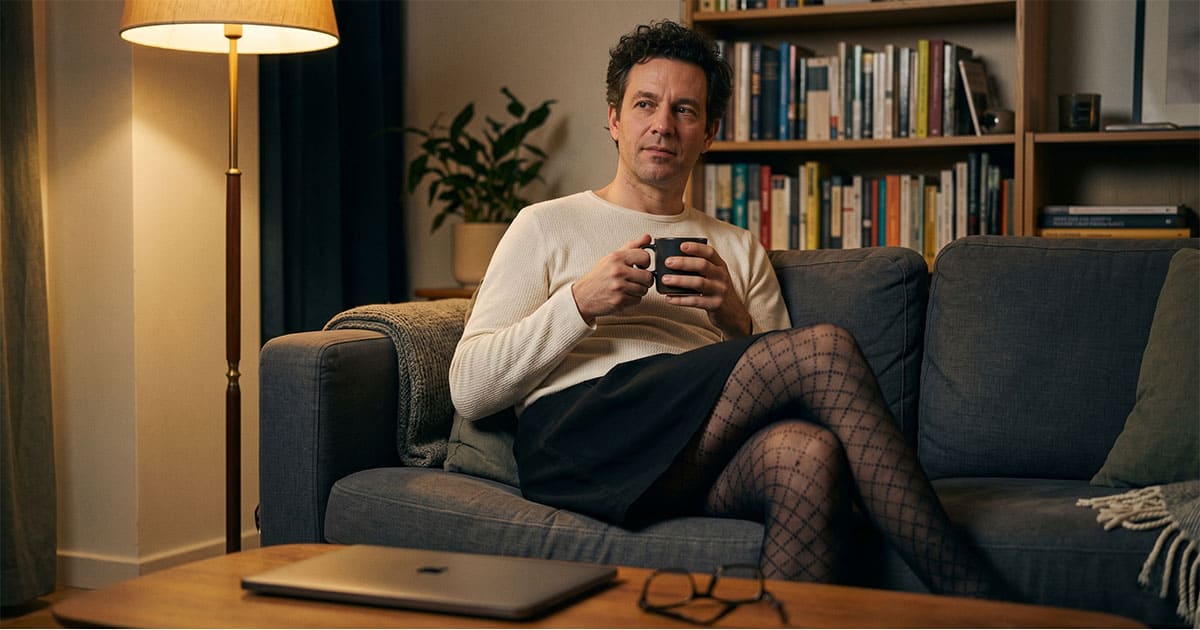
Pick an evening when you'll be home alone for at least two hours. Take a shower. Get dressed slowly. Wear the full outfit — skirt, top, tights, shoes — and just exist in it. Make tea. Watch a show. Read. Sit on the couch.
This first hour of nothing-special is what tells you whether you want to do this again. Performance pressure (camera, mirror posing, dressing up for someone) distorts the answer. The quiet hour gives you the real one.
The five most common beginner mistakes
- Buying lingerie before any other piece. Most emotionally loaded item, biggest fit challenges. Save it for your third or fourth order.
- Going straight to a wig and full makeup. Three difficult skill curves stacked into one evening produces frustration. Add one skill at a time.
- Telling your partner before you've worn anything once. Some partners take it in stride; most appreciate hearing about it once you understand it yourself. Your first wear is for you, not for negotiation.
- Buying without measurements. Women's sizing is brand-by-brand chaos for male bodies. Measure waist, hip and chest in cm and use each retailer's actual chart.
- Photographing the first wear and judging it harshly. First-wear photos rarely match the mirror reflection because of camera lens distortion and the asymmetry your brain isn't used to. Don't make permanent judgments from a single selfie.
What about size, shoes, and fit issues specific to crossdressing
- Women's clothing size: measure your chest, waist and hips. Compare to each retailer's published size chart in cm. Most beginners land in size L or XL for women's tops because shoulder width is the limiter, not chest.
- Shoe size: women's shoes typically run 1.5 to 2 full sizes larger than men's. A men's US 10 is usually women's US 11.5-12. Wide-fit options exist at most retailers.
- Bra fit: if you're using breast forms or bralettes, your band size is your underbust measurement in cm. Cup size is determined by the forms themselves, not measurement.
- Shapewear: high-waisted shapewear briefs are the simplest entry point for getting a feminine silhouette. They smooth the waist and give skirts a more natural drape on a male torso.
How a virtual try-on changes the beginner experience
Until recently, every part of beginner crossdressing involved at least one anxiety-producing step — going into a store, opening a return at a counter, asking a sales associate, ordering "blind" hoping the fit would work. Virtual try-on tools remove most of those.
The simple version: upload a photo of yourself, upload a photo of an outfit you're considering, see how it actually sits on your body before placing the order. You get the size-fit insight that previously required physically trying things on — without the store visit, without the changing room, without anyone seeing.
For crossdressers specifically, this is the difference between "I'd order if I knew it would fit" and an actual order. FemStyle AI is built for exactly this — photos auto-delete after a short window, nothing is shared, generations live only in your private gallery.
For the rare moments when seeing yourself in a photo isn't enough — for example, when planning a special evening or photoshoot and you want to see the look in motion — there's also a video generation that turns a single photo into a short clip of yourself in the outfit, moving naturally. Many crossdressers describe the first time they watched themselves moving in a full feminine look as the moment everything clicked.
Try your first outfit on yourself, privately →
Once you've worn an outfit once and want to think about photographing the experience, our next guide on photographing your crossdressing looks at home walks through the safest, most private setup.
Frequently asked questions
What's the safest first crossdressing outfit?
An A-line knee-length skirt, a simple blouse or wrap top, opaque tights, and flats. All in neutral colors. Total spend under $100. Easy to order from any large retailer, easy to wear privately at home, and the cuts are forgiving on most male bodies.
How do I order crossdressing clothing without my family seeing the package?
Use a pickup point at a supermarket, locker, or kiosk — the package never comes to your home. Order from large generic retailers (ASOS, H&M, Amazon, Shein) whose packaging has no obvious branding. Invoices may list item names; the outer box does not.
Where should I keep crossdressing clothing if I live with family?
A lockable suitcase or hard-sided travel trunk stored in a closet or under the bed. Looks like normal luggage, opens only with your key, and explains nothing if anyone asks. Self-storage units are a slightly more expensive alternative if home really isn't an option.
Should I tell my partner before I try crossdressing?
Most experienced crossdressers say to wear the outfit yourself first — once, privately — before deciding how or whether to bring a partner in. You'll understand the experience better and can describe it more clearly. Disclosure before any first wear often turns the conversation into negotiation, not sharing.
What women's clothing size should I buy?
Measure your chest, waist and hips in cm and compare to each retailer's actual size chart — not the letter size. Most male bodies land in women's L or XL for tops (shoulder width is the limiter) and one size up from the chart for skirts (waist sits at a different height on male hip bones).
What's the safest way to see if a women's outfit will fit me without going to a store?
Upload a photo of yourself and a photo of the outfit to our virtual try-on — it shows the outfit on your real body, your real shoulders, your real proportions. You get the fit insight in a minute, without a store visit and without ordering anything yet.
Is crossdressing the same as being trans?
No. Crossdressing is wearing clothing associated with another gender, often as a specific activity. Most crossdressers identify as men. Being trans is about gender identity itself, not clothing. The two can overlap in a person's life, but they're different experiences and don't imply each other.